The Hirschy Newsletter

for descendants of Philip and Julianne (Frey) Hirschy
April 1995 No. 6

Return to the Newsletter Index.

Top |Page 1 | Page 2 | Page 3 | Page 4

THE WEST COAST
HIRSCHY GATHERING

  Those who were able to
attend the HIRSCHY
GATHERING an Feb. 25. in
the Granada Hills Community
Church, had an enjoyable
time. Family informtion
and stories was shared and
just being together was
meaningful. We give a word
of appreciation to all who
made this a meaningful time
and especially to Esther
and Paul Sauder for serving
as hosts.
  Coming from a distance
were 4.6.3.3.3 Joyce Giles
of Vallejo, CA; 6.5.8.1
Esther Parker of Prescott,
AZ; and 4.5.5.2 Jeannie and
Carl Crouthamel of Green
Valley, AZ.

LETTERS

  Here are letters that
have come to the editor.

From Leonard Augsburger
(1.5.2.3-2.3) John
Hirschy (1) hold 160 acres
(not 80 as the book says),
the whole NE.R 1/4 of section
2 Hartford township. This
can be seen on the 1874
plat map of Adams county.
According to a land
abstract I saw of the
property, John Hirschy
purchased 239 acres for
$700 from Christian
Luginbill (who had
homesteaded tho property)
on May 20, 1947. This
property was the NE 1/4 and
east half of the NW 1/4 of
section 2. The east half
of the NW 1/4 was then sold
to John Augsburger on
5/9/1861 for $1400, leaving
John with 160 acres. The
children of those two (John
Augsburger and Verena
Hirschy) who then grew up
on adjacent farms, later
married. Later, the 1896
plat map shows that the 160
acres are in the name of
Christian Hirschy
(presumably John Hirschy's
oldest son)."


"You have given me the
heritage of those who fear
your name." Psa. 61:5 NIV

"The righteous ... will be
remembered forever."
Psa. 112:6 NRSV


THE CURRENT
GENERATION

  A major publication that
just recently came off the
press was written by Alfred
Habegger (4.5.5.1.1) The
title of the book is: The
Father: a Life of Henry
James, Sr.
. It was printed
by Farrar, Staus & Giroux.
Reviews appeared in the
"Now York Tines Book
Review" on Jan. 8, 1995,
and in the "Now Yorker" on
Jan. 6, 1995.
  Alfred Habegger is
Professor of English at the
University of Kansas. The
publication is the
culmination of five years
of research and writing on
an important figure in
American literary circles.
  The book jacket has a
statment by Jean Strouse,
the author of a biography
of Alice James, a daughter
of Henry James, Sr.
"Henry James, Sr., who has
until now has seemed a
brilliant, elusive shadow
in the lives of his
children, here takes on
vivid dimensions of his
own. In this fascinating
account, Alfred Habegger
has found troves of new
informtion, and looks at
familiar material in new
ways."
  The publisher has
written, "Henry James,
Sr.'s children included
William, the psychologist
and philosopher; Henry Jr.,
the novelist; and Alice,
author of a noted diary.
What kind of father stood
behind his epochally
brilliant, original,
energetic, and often
troubled progeny? A noted
writer himself, whose
friends included leading
American thinkers of his
time, James was a
passionate, contradictory
character. Alfred
Habegger's The Father is
the first biography that
attempts to capture the
bewildering complexities of
the James Father's public
and private history - his
early engagment with a
radically deviant
Calvinism, his stunning
embrace of both
authoritarian and
democratic systems of
ruling, his rich humanity
and comic gifts, and his
dealing with the most
interesting people of his
time. Henry Sr. had a
headlong drivenness that
took on a maniacal edge
following his loss of a leg
in adolescence, and as a
father he turned the full
force of what he was on his
children. Impeccably
researched and written,
Alfred Habegger's account
of Henry Sr.'s tumultuous
life in a major new
contribution to American
biography."
  Here is the way Alfred
Habegger begins the
biography:
  "In the thousands of
manuscript pages he left
behind - essays and lectures
and treatises and thirty-
page rebuttals of
unfavorable reviews - he
never lets up. He is
always going at some
antagonist who hasn't
reached first base in the
spiritual world and has
nothing of valuo to say,
always setting this third-
rater straight about the
nature of things. "Mind
well what I say here,' he
constantly demands.
  "Then again, he left
hundreds of splendid
personal letters, some of
the more witty, charming,
warm, and open than
anything his gifted
children were able to
write. In these he seems
endlessly inventive with
so mch ingenuity of
expression, so masterly a
tonal range, and such a
superb feel for the nuances
of relationships that one
willingly forgets that
blocked and monomaniacle
hierophant.
  "And then, but much less
frequently, one comes upon
documents of a third kind.
These are the pages in
which an embittered devil
come to life, with a piece
of wood where others have
flesh and feeling. He
wields a pen dipped in his
own bottomless well of
long-distilled guilt and
anger. He has a tail
formed of his own
lengthening invisible past,
and from time to time as he
writes at his desk it whips
into view and stings him
into madness."
  Alfred Habegger lives in
Lawrence, Kansas and in
rural Oregon where he and


Top | Page 1 | Page 2 | Page 3 | Page 4

his wife Nellie (Weaver)
have built a log house from
trees which they felled and
trimmed to meet their
specifications.

   *   *   *   

  The Mar. 10, 1995 issue
of the "Berne Tri-Weekly
News" featured 6.11.3.2.4
Brad Zehr.
  "Brad Zehr, son of Paul
and Marilyn Zehr of rural
Berne, and member of the
South Adams High School
Band directed by Curt
Amstutz, has been selected
to participate in the 1995
Indiana All-State Honors
Band sponsored by the
Indiana Bandmasters
Association."
  "Each student earned
his position by participant
in a highly competitive
audition held on January 8
at one of eight centers
throughout Indiana. Nearly
1,300 high school students
applied for membership to
this year's band. A tape
recorded audition process
concluded the selection
process for this year's
band. 208 of the top high
school bandmen have been
selected for participation
in the 1995 Indiana All-
State Band Conference."
  "In addition to the
regular Indiana All-State
Band, there is a very
select Honor's Band. This
94 piece Indiana All-State
"Honors" Band will be
directed by Ray S. Cramer,
Director of Bands at
Indiana University. The
114 piece regular Indiana
All-State Band will be
directed by Paul K.
Holcomb, Director of Bands
at Central College in
Pella, Iowa."
  The culminating concert
was presented March 12 in
the Clowes Memorial Hall,
Butler University,
Indianapolis.
CONGRATULATIONS BRAD!


Picture text

Brad Zehr selected All-State
Honors High School Band.
The Life of
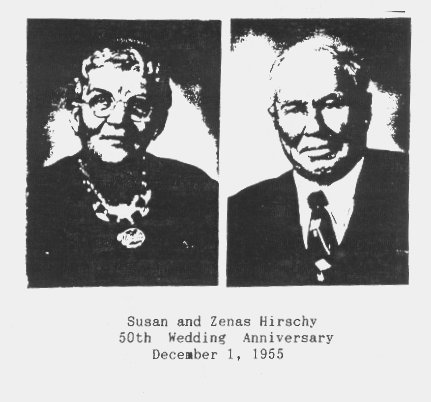
Zenas Hirschy (4.6.3)

by Irene (Hirschy) Pape
(4.6.3.3.) and Joyce (Pape)
Giles (4.6.3.3.3)
  Zenas Hirschy was born
in the Berne, Indiana
comunity on May 29, 1882.
He was the third child of
Peter Hirschy and Susanna
Bandy. The Hirschy family
were members of the De-
fenseless Mennonite Church.
Zenas said his mother was
born in Allen County, Ohio
to an Amish family. She
used to cook typical Amish
dishes.
  In 1901, when Zenas was
19 years of age, the Peter
Hirschy family moved to
Surrey, North Dakota. The
opportunity of Homesteading
open land attracted them.
This was made possible by
the Federal Homestead Act.
Two years later, in 1903
when Zenas was of age, he
took up a homestead at
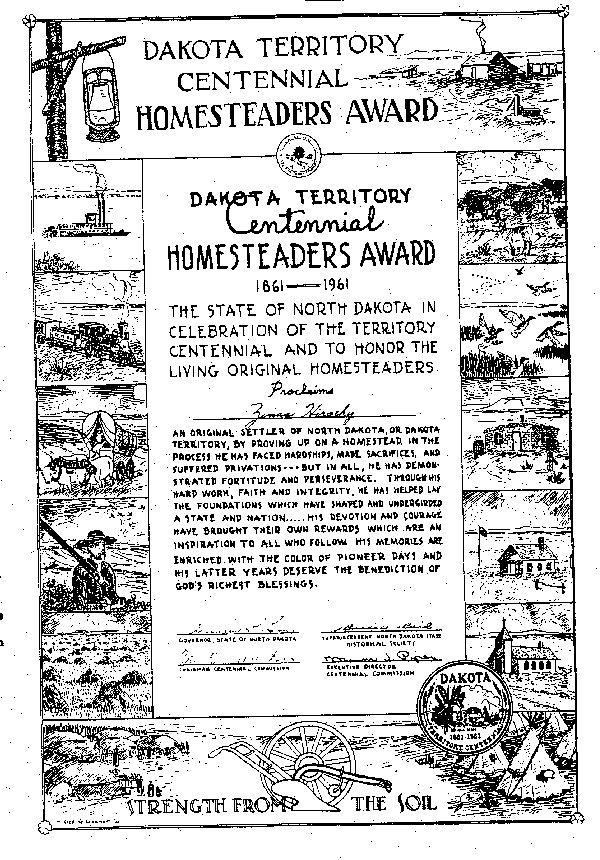
Surrey on his own. Thus he
was one of North Dakota's
pioneer home-steaders, and
received a certificate from
the governor of the state.
  On December 1, 1905
Zenas married Susan Molvina
Berry in Minot, North
Dakota. She was the
daughter of Jerome and
Irene (Chidester) Beery and
was born in Knox, Starke
Co., Indiana Dec. 3, 1884.
She had an older brother,
Earl, and an older sister,
Gertrude; a younger sister
Bertha, and a younger
brother, Carl. Her father,
Jerome Beery, was born in
Hocking County, Ohio, March
1, 1851 and died in Knox,
Indiana. He had married
Irene Chidester on Feb. 28,
1879. He was a carpenter
and the family belonged to
the Methodist Church.
  When Susan was 16 years
old she had typhoid fever
and was paralyzed for a

time. During her illness
Gertrude had a daughter who
died on a Sunday night and
her brother, Earl, age 18,
died of typhoid the follow-
ing Friday. Her father,
Jerome, died the next day,
on Saturday. When Susan
recovered she had to give
up any thought of continu-
ing her education and went
to work to help support her
younger brother and sister.
  Susan worked for families
in Chicago. Working as a
maid was not always
pleasant. One family would
not let her bathe in their
bathtub even though they
washed their dog in it.
When she was twenty she
moved to North Dakota to
work. There she met and
married Zenas.
  Together they farmed the
homestead at Surrey for
four years. Two children
were born here: Opal Esther
on Mar. 3, 1907 and Pansy
Emmaline on Sept. 11, 1908.
  In 1909 Susan had some
health problems. Because
they suspected it was
tuberculosis, they decided
to move to California.
Zenas rode with the house-
hold goods and livestock on
an imigrant train. Susan
and the two girls rode on a
passenger train.
  They settled near Kerman,
a town 15 miles west of
Fresno. Here the last of
their three children,
Susanne Irene, was born
Oct. 29, 1913.
  In California they raised
alfalfa. Susan sent a post
card to her mother and
brother Carl on which she
wrote: "Zenas is putting
gates in the field and the
girls are with him. We
will have over $200 worth
of hay to sell of the first
cutting from 12 acres. We
want to hold the rest until
later. Hay will be $15 to
$18 by spring. We had
about 24 tons this cutting.
Zenas cut some, and that
made over 3 tons to acre
that cutting."
  Susan's health improved
and they learned she did
not have T.B. So in 1915
they decided to move back
to their farm near Surrey,
North Dakota. It was Zenas
love for the type of
farming in North Dakota as
well as the presence of
members of his family that
led them to decide to
roturn. Zenas also felt he
could make a better living
in North Dakota for they
owned the farm and it had


Top | Page 1 | Page 2 | Page 3 | Page 4

good soil. On their return
Zenas again rode the
immigrant train with the
household and farm
equipment and animals while
Susan and the three girls
rode the passenger train.
  On their North Dakota
farm the family had several
dogs. Irene wanted to
bring one of them into the
house but Zenas would not
allow it. He said, "If the
dog gets to where he can
open the door, he can come
in." Irene wanted that dog
to open the door so bad,
but he never learned the
feat.
  One day Irene and a
friend decided to walk to a
neighbor's house about a
quarter mile away. Since
they were small it seemed
to take forever to get
there. When they arrived
the friend's mother was
worried about their coming
without permission. She
phoned Susan who said to
send them back home as soon
as possible. An older man.
who was a friend, came by
with his horse and buggy
and the girls were promptly
sent home with him. What
Irene remembers about that
ride home is that the man
had a big grandfather's
clock in the back of his
buggy.
  Though their address
was Surrey, they lived in
McHenry County. Since
there were no busses to
take the girls to school,
they roomed with families
in Velva. They also worked
for their room and board.
Pansy and Irene usually
roomed together.
  In the community where
they lived there were no
Mennonite Churches so the
Hirschy family attended
Methodist churches. Later
Zenas and Susan joined the
Nazarene Church. They made
the shift because of the
care and kindness of
Nazarene families. They
had a number of long tine
friends in this church.
During World War I
Zenas was deferred from
military duty since he was
a farmer and had a family.
Grain farmers were needed
to raise crops "to feed our
boys", he would say.
Whenever he talked about
"our boys" Irene would
think she had brothers
somewhere. Later she
learned the phrase referred
to soldiers in the army.
  In 1922 the family
moved to Velva. Here Zenas
worked in various lignite
coal mines. Later he
purchased a mine of his own
which he operated for
several years. Susan cooked
for all the hired help.
She also did laundry. This
was done by hand using a
scrub board. After Zenas
sold the mine, he went into
the trucking business,
hauling grain in summer and
coal in winter. During the
summer, Zenas made
contracts with various
schools to fill their coal
bins in preparation for
winter. The youngest
daughter, Irene, remembers
going with his on many Of
these deliveries. They
would start out early in
the morning. Once the
deliveries were made, since
he was tired, Zenas would
become the passenger and
let Irene, at the age of
twelve, drive the Chevrolet
truck home.
  Zenas had his hauling
business until into his
60's. Upon retirement he
enjoyed working in his
truck garden. He grew
various berries, apples,
and vegetables. Since he
was known in the area as an
expert gardener, he had no
problem selling his fruits
and vegetables.
  Zenas and Susan
continued to live in Velva.
She died Nov. 13, 1965.
She had not enjoyed good
health and suffered her
first stroke at age 48.
She was 80 when she passed
away. Her death resulted
from complications
following a broken hip,
Zenas died from pneumonia on
March 19, 1967. He was 84
years old when he passed
on. Surviving him at the
time of his death were the
three daughters: Opal
Berge, Pansy Fletcher,
Irene Pape, ten
grandchildren and twenty
great-grandchildren.
  Opal Hirschy went to
Montana to work. She
became a housekeeper for
Ole Berge and married him
Sept. 24, 1941.
  Pansy Hirschy learned to
know Willard Fletcher as a
child. Willard's father
married Zenas' sister
Magdalena Hirschy (4.6.8)
in 1905 after the death of
his first wife. When Pansy
was 14 Willard wanted to
get married and homestead
in Canada. Pansy refused
at the time. She married
him at age 20 on Nov. 28,
1928.
  Irene Hirschy and Paul
Pape met at a barn dance.
which was a very popular
activity of the farming
community. The hayloft of
a barn was cleared of
enough hay to have a large
enough area for the dance.
  Russel, a nephew of
Pauls. remembered being at
the barn dance when Irene
and Paul met. He was to
accompany them to a
subsequent barn dance.
Paul wanted a hair cut to
look nice for the date and


Top | Page 1 | Page 2 | Page 3 | Page 4

Russel told him he could do
it, though he had never cut
hair before. Paul let him.
Russel did such a bad job
that Paul was ready to
"kill him." When Paul came
to pick up Irene for their
date, she asked, "Where is
Russel?" Paul merely
answered, "Oh, he couldn't
come." Other social
activities of the farming
community were evening
walks, visiting on porches
with neighbors, and playing
Whist, a precursor to
Bridge.

A
NEWSPAPER ACCOUNT

  The following newspaper
clipping from a 1958 issue
of The Berne Witness has
came to our attention. It
is about John Richer who is
mentioned in The Hirschy
Genealogy at the bottom of
page 47. He befriended
Noah Hirschy during his
stay in Louisiana.

JOHN M. EICHER
DIES ON WEDNESDAY
  FORMER RESIDENT TAKEN
    BY DEATH AT
    BATON ROUGH, LA.

  John M. Eicher, 73,
fomer resident of this
community, died at Baton
Rouge, LA., on Wednesday,
February 19, according to
word received here. Death
was attributed to a heart
ailment. His wife preceded
in death a few years ago.
Two children, Ruth and
John, Jr., and four
grandchildren survive.
  Two sisters, Mrs. Effie
Schwartz of Michigan and
Mrs. Fanny Allread of Troy,
Ohio, and a brother,
William Eicher of
California also survive.
  Eicher was taken into
the Philip Hirschy home
when a lad and later into
the C.P. Hirschy residence.
  Eicher entered the
lumber business at
Marysville, Ohio. Later he
moved to Texas, then to
Baton Rouge, LA. He was in
the insurance business
since retiring from the
lumber business.
  The funeral and burial
will be at Baton Rouge.

  John was the son of
Peter and Cilucia (Pool)
Eicher. His parents
divorced and the children
were placed in various
homes. By the time he came
into the Philip Hirschy
home, Noah would already
have moved out but would
have had opportunities to
know him.. In later years
John looked for his parents
and upon finding his mother
supported her in her old
age. He never located his
father.

   *   *   *   


PUBLICATION
INFORMATION

  The Hirschy Newsletter is
Published four tines a
year. Cost is $5.00 for
four issues.
  The editor is David L.
Habegger, 6929 Hillsboro
Ct., Fort Wayne, IN 46835.

  If you have material you
would like to submit for
publication, send it to the
editor.
  In correspondence please
use the number behind your
name to identify yourself.


Top | Page 1 | Page 2 | Page 3 | Page 4

Return to the Newsletter Index.

E-mail the Author