The Hirschy Newsletter

for descendants of Philip and Julianne (Frey) Hirschy
January 1995 No. 5

Return to the Newsletter Index.

Top |Page 1 | Page 2 | Page 3 | Page 4| Page 5| Page 6

A WEST COAST
HIRSCHY GATHERING


  If you live on the West
Coast, you can attend a
HIRSCHY GATHERING on Feb.
25. It will be held in
the Granada Hills Community
Church, 11263 Balboa Blvd,
Granada Hills, CA 91344,
beginning at 2:00 p.m. A
carry-in meal will begin at
4:00 p.m. and the program
will begin at 5:00. The
local contact person is
Esther Sauder, 10112 Crebs,
Morthridge, CA 91325. Her
phone is 818 / 349-1947.
If you plan to attend, send
her a note. Registration
is $5.00 per family and
$2.50 for singles.
  This GATHERING will give
you an opportunity to meet
your Hirschy relatives, and
to learn wore about your
family history. David
Habegger will be present to
tell the history of the
family and will show slides
of Switzerland and France
that illustrate our story.
  Inform your relatives,
who may not have received
this newsletter, of this
occasion and plan to
attend. Come even if you
can't decide until the day
of the Gathering.

LETTERS

  Here are letters that
have come to the editor.

Russ & Sherry Clair 5.7.1.?
Rochester Hills, mr.
  "Just a quick note to let
you know we read your
paragraph about new
contacts in the Newsletter.
  We will be sending you
the update as soon as we
can get some of it together
in a convenient form and I
have contacted everyone.
  On Joseph C.
Klopfenstein's (5.7) side
(Armintha Barnes) we have
some exciting news. Joseph
C. Klopfenstein and
Armintha Barnes had:
Edison, Sadie and Dora.
Sadie's son Charles Stamm
Jr. sent us a big box of
pictures. I had spoken to
Dora's daughters Velma and
also Myrtle and they said
Charles, their cousin, had
pictures. In the box was a
newspaper clipping and
because of that clipping we
were able to find 2 half
sisters we did not even
know existed, I will
send you the whole story
but for a condensed version
- Harold is 81 and Audrey
is 74. Harold is in Texas
and Audrey in Toledo, Ohio.
Audrey married a Harold and
named one of her sons
Lester. On Nov. 27 we are
going to Toledo to meet
everyone and on Dec. 3-7,
Audrey and her son and my
husband are flying to Texas
so Audrey can meet her half
brother 'Harold. She said"
I WANT TO MEET MY BROTHER."
  Everyone is all happy and
they will video tape the
meeting and the Brownsville
Herald is sending a
reporter over to take their
picture and write a story
about it in the paper.
  Many wonderful human
interest stories have
resulted and I do have a
lot to send you but must
get it all together and am
working on it.
  The strangest thing also
happened - I glanced in the
phone book for Rochester
Hills, HI. and there was
a Ray Kopfenstein. I
called and lo and behold he
was one of the people who
supplied you with a lot of
info on the Klopfensteins
for the book. Right down
the street from us!
Couldn't believe it! Can
you imagine?
  Well you will be hearing
from us as I get all this
organized.
  Thanks again, Happy
Holiday Season to you all."

Ora Lee Rea (4.6.2.6) North
Little Rock, AK.
  "I am sending a
correction in the book on
Charles Odell Hirschy
#4.6.2.1. The sentence -
'He and Rachel served as
missionaries in Alaska for
about forty years' should
read 'He and Emma
served...'
  Thanks a lot and have a
Blessed Christmas. Your
cousin.

Neva Basey (6.1.4.1.2) Lake
Panasosffkee, FL.
  "A few lines to let you
know that we received the
book and newsletter.
Wanted to thank you for all
the hard work that you have
done. Haven't had time to
really get through it.
  We have traveled a lot
this summer, for which we
are thankful that we are
able to do so.
  Had a very hot summer 90-
100 for a long time.
Finally got some much
needed rain.
  I knew there were a lot
of relatives, but never
thought of that many.
Learning a lot of the back
ground.
  Thank you again."

Betty Scott (6.1.3.2.1)
Columbia City, IN.
  First of all, I want to
apologize for not writing
to you sooner and thanking
you for such a wonderful
family reunion. I do
appreciate all your hard
work.
  I also wanted to tell you
I think your book is most
remarkable and accurate in
your information.
  We plan to come to the
next reunion also, and I'd
like you to autograph my
copy of your book. It is
such a complete book of
family statistics.
  My aunt Joan (Weber) was
sorry she was unable to
attend the reunion.
  Today I received the
latest copy of the Hirschy
Newsletter. I always enjoy
reading this. Thank you
again for all your hard
work and wonderful book.
  P.S. I really enjoyed
meeting and visiting all
the various members of the
family, especially the Zehr
family."

Joyce Giles (4.6.3.3.3)
Vallejo, CA
  "Thank you so much for
helping me with my
pictures. I was able to
just about complete my
booklet of the reunion... It
has been very interesting
for me to learn so much
family history. I have
sent in the request for
further information on the
trip to Switzerland next
June. While writing this
letter, my husband ran in
to tell me that an
educational travel program
is showing Berne,
Switzerland on TV, so I
stopped for a while to
watch it. Looks like
beautiful scenery.
  I was very close to my
grandfather (Zenas) as a
small child until I moved


Top | Page 1 | Page 2 | Page 3 | Page 4 | Page 5 | Page 6

to California in 1945, so
learning so much about his
ancestry has kept that
bond. Until I was 8 years
old I lived next door.to
him, and I was his constant
pointed. I am glad you
pointed out that Peter
Hirschy was born in the
Louis Hirschy house. I had
read a lot about Zenas'
past before I came there,
but it still didn't
register until I got home
that he was born in Berne
also.
  I already had a complete
write up on Zenas Hirschy's
life. My mother has kept
us all well informed on
both sides of our family,
and she wrote short
biographies for us a few
years back. My niece
needed the information for
a school project, so in
helping her, my mother also
passed along the
information to the rest of
us. If you can include
Zenas' life in a
newsletter, our family
would be very pleased.
  I only know what you put
in the genealogy book on
Peter Hirschy. I only met
Solomon and Paul, two of
Zenas' brothers. Solomon
used to make trips from
Canada to visit relatives,
and Paul and his wife Hazel
lived in Oregon. We
stopped in to see them when
our children were young.
They took in foster
children for many years,
and once when my parents
were visiting, they
received a commendation
from the Governor. They
took in handicapped and/or
retarded children. Paul
visited us in California on
two occasions. I remember
he played his accordion for
US. My mother might
remember more information
on them if any of that
sounds interesting for a
future newsletter.

  Yes, I met our cousins
from Canada. I sat and
visited and looked at
family photos with Phyllis
Thrasher. My mother gave
me her address before
coming to Indiana, so I
wrote to her to introduce
myself prior to the
meeting. My husband took
our picture together for my
mother.


"Children's children are a
crown to the aged."
Prov. 17:6


THE CURRENT
GENERATION

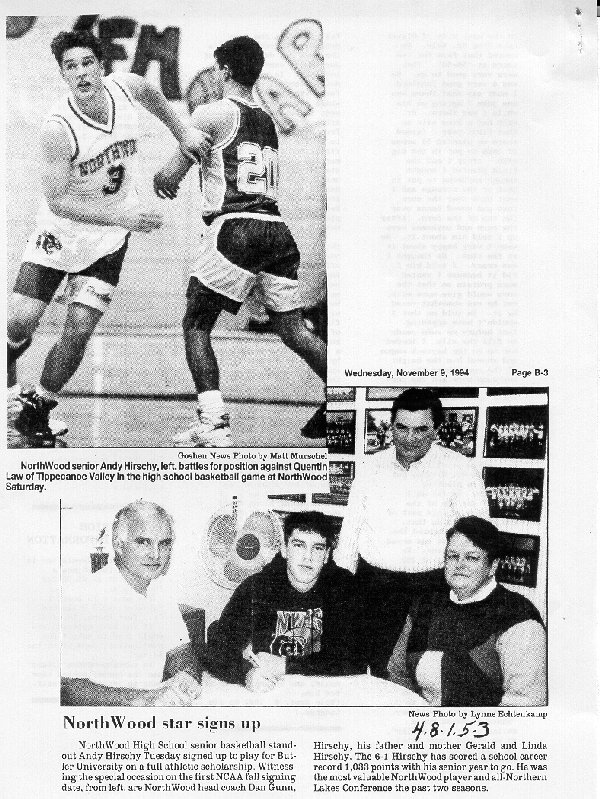
  The Goshen News has
recently carried a number
of articles about an
outstanding athlete named
Andy Hirschy (4.8.1.5,3 1)
son of Gerald and Linda
(Grossman) Hirschy.
  Andy plays basketball in
North Wood High School and
recently set a new school
record of total points
scored. In a game against
the Tippecanoe Valley
Vikings he reached a career
total of 1,127 points. The
game was halted to
recognize his new record.
  He is quoted, "Before the
game everyone was talking
about it. I really didn't
think about it. I wanted
to play a normal game and
if it happened tonight that
was fine. I'm glad it's
out of the way early in the
season.
  Andy hit six of eight
shots and was perfect in
nine trips to the charity
stripe.

  NorthWood coach Dan Gunn
said of Andy, "this was a
typical effort of his. I
can think of very few games
where he hasn't played all
out. But that's why he is
where he is."

  Last year Andy scored 470
points with an average of
20.4 per game. That is
second in single season
scoring. He is expected to
surpass that this year.

  LeRoy Lambright, sports
editor for the Goshen News
wrote, "The versatile
Hirschy, who has a good
outside shooting touch and
scores with twisting moves
and excellent body control
inside, tallied a career-
high 34 points in a 73-52
triumph at West Noble this
past season. He led the
Panthers in 3-point shots
made with 20."

  We will probably be
seeing him play on national
television in years to come
for he has made a verbal
commitment to attend Butler
University on a full five
year basketball scholar-
ship. This is worth
about $100,000. He plans
to study pharmacy.
***
  Another Hirschy
descendant, who has done
well scholastically, is
Christina D. Ross
t'4.5.5.3.1.1), daughter of
Archie and Barbara (Fretz)
Ross of Woodland Park. CO.
This past May she graduated
Summa Cum Laude from
Colorado University of
Boulder, CO.
Congratulations!


The Later Life Story
of Manes Hirschy

  Adapted from what was
written by Jim Langham
(4.8.4.6.1), a great-
nephew. He lived longer
than any Hirschy descendant
- 103 years, 2 months and
12 days. This story is
continued from the last
Issue.

  When Stella and I were
married I was working for
Millard Smith on the John
Nelson Kerr place. She
also had worked there for
some time. At Christmas
time we quit and commenced
housekeeping.
In May of 1904 I hired to
Louis Habegger and I worked
for two years with 3 days
vacation for $365 per year.
During this time we lived
in an old big log house on
the Sam Zurcher farm, back
of the road towards the
town of Berne. In the fall
of 1904, when the garden
was gathered in, we moved
to the town of Berne to the
first house west of the
Gilliom Lumber Company. It
even had a barn on the
property.
  On December 27, 1904
Virgil arrived. He was so
tiny that we made his bed
in a rocking chair, for
that was all we had at that
time. I called up Mr.
Gates the next morning for
them to come and see the
new boy, which was the
first grandchild in the
family, lola was the first
to come and see the new
boy. She was ready to sit
down in the rocking chair
so Mom screamed, "Don't sit
down on the baby!" He only
weighed two and a half
pounds. In two weeks, my
wife Stella was back to her
Sunday School Class. She
taught the same class until
we moved to LaGrange County
in the fall of 1916.
  Since I'd always been a
farmer, after working for
Louis Habegger, I rented 73
acres off of Lewis Rolander
in Jefferson Township for
three years. While there
Elton arrived on Kay 22,
1906. It was beautiful
weather and Mom was in the


Top | Page 1 | Page 2 |Page 3 | Page 4 | Page 5 | Page 6

act of cleaning house early
and we had taken the stove
out of the house for the
summer. But the day the
baby came it turned cold so
I went to the neighbor's to
see if he would come and
help me move the stove in
so we would have some heat.
The next day I stopped in
to ask them to come see the
new baby. They said, "What
baby?" His first words
was, "Where did you find
that?"
  On Nov. 15, 1907
Kenneth was born. He was
the one that died the year
we were in Maryland, Jan.
19, 1919.
  While on the Rolander
place we planned on moving
to Midland, Michigan, where
John Gates, my wife's half
brother, lived. We had a
sale, but the sale fell
short so I hired out to
Jonathan Rumple for two
years. Since we had the
sale in the fall I had to
find a place to move to so
we moved to the Boze
property and I walked one
and a half miles each day
until spring when we moved
to Irvin Kerr's property.
  It was on May 1, 1910
that Clyde was born. He
had a heart disease and
lived only a few months.
He never got out of the
crib.
  I then rented the Mark
Burdge place for two years
for cash in 1912. On
August 31, 1912, Harold was
born. In those days the
doctor came to your house
to deliver the baby. Old
Doc Reusser came out three
miles east of Berne in the
forenoon to see how things
were going and then went
back to town to serve
calls. After dinner mom
got in a hurry. The boys
always took a nap after
dinner, so we took then out
of their nap and told them
to go to the neighbor's
place south of our place to
phone the doctor and tell
him that mom was bad sick.
Hand in hand they rand down
the road as telephones were
few in those days. With a
house full of patients the
doctor came about thirty
minutes later, sleeves
rolled up, but it was all
over. The baby was crying
for bloody murder when he
got there. He did what I
couldn't do and went back
to his office. How's that
for service?
  We lived on the Burdge
place until our contract
was ended and again we
moved to the Fin Striker
place, just east of Spring
Hill Methodist Church. We
rented that place and lived
there until the fall of
1916. That's when we
decided to follow William
Eley to LaGrange County.
It was nice sandy ground
and no clods to work down.
  Oh yes, before I go on
with that, I wanted to say
something about my first
car. It was a 1915 Model T
Ford and I bought it from a
fellow in Geneva. I had
never been behind a
steering wheel in my life,
but he talked me into
giving it a try and so I
drove it home from Geneva.
  Now back to the original
story. Mr. Eley contracted
a farm in Eden Township, 5
miles northwest of Topeka,
Indiana and sowed a field
of wheat for me. It had
good buildings on it, but
no one was living on it.
We rented for "50-50" and I
moved by team and wagon the
100 miles with cows and
heifer coming fresh, 3
gilts, 3 dozen chickens
with horse and carriage
tied behind the wagon. I
got my brother-in-law to
accompany me in case of
trouble. We loaded it at
9:00 Thursday morning.
  When we got to Monmouth
we discovered the horse had
disappeared so we pulled to
the side of the highway. I
started walking back an
foot as we decided that it
couldn't be far for a mile
back it was still tied to
the wagon. I found it in
Monmouth school yard
fastened to a pile of fence
posts, waiting for me.
That was luck number one.
When we got further north
we found a section of
highway closed and the day
was well spent. We found a
kind farmer that let us
pull within the barnyard
for the night.
  I let the team loose in
the barnyard for the night.
It was nice so we slept out
in his barn. But he first
sized us up and asked us if
we smoked. He told us that
the highway was closed
further to the north so we
had to detour to the
northwest over a big hill
that took us about two
hours. We could only pull
to the length of the wagon.
Then we had to put a stone
under the wheels and rest
the horses. That took two
hours of the time. We
didn't unload the second
night so we just kept the
horses tied and slept in
the wagon,
  We arrived in Ligonier on
Saturday. We found a
livery barn and fed the
horses and then went to a
restaurant for a hot meal.
At that time we were seven
miles from what was going
to be home. We unloaded
and Mr. Eley took us to his
home for the night. We
didn't get to bed before my
helper asked what time the
next train went south. it
would be at 4 a.m. on
Sunday morning. So I paid
Mr. Eley to take him to the
train. I was just too
tired to see him off.
Sunday morning the Eleys
took me to the farm that
was to be home then they
went to Sunday School and
church.
  Once I was unpacked and
settled, my wife Stella and
the children came as far as
Wolcottville by way of the
GR&I railroad. There Mr.
Eley picked them up with
his Model T Ford and
brought them to his home in
Eden Township until Sunday.
our implements and
furniture were shipped by
freight before we left
Berne, earlier in the week.
The first week was spent in
cleaning house. We stayed
there for less than a year.
  I then went to work for a
Mr. Asher. The first day I
worked the job for him I
was sowing grass seed. The
field was 80 rods long.
The first round I sowed he
sat on the rail fence and
watched how I was doing.
The second round he had
disappeared before I got
back. And so it was the
most of the year. But the
joke was to have found work
from six a.m. until six
p.m. which was just fine.
But that's the year the
country went on fast time.
I was supposed to take care
of my team, milk my cow and
get to the field by six.
That meant getting up early
in the morning. But the
evenings were fine. I
never had it any better.
That's the year Cletus was
born, July 25, 1918.
  Mr. Eley bad moved to the
state of Maryland as it
looked like prospects were
good for work there at that
time. I sent my team to
Maryland as I planned to
follow Mr. Eley to
Maryland, but I had to work
my time out with Mr. Asher


Top | Page 1 | Page 2 | Page 3 | Page 4 | Page 5 | Page 6

as I needed the money.
  We went to Barkley,
Maryland, but luck was
against us. We contacted
Diphtheria, that was going
around at that time, and on
Jan. 19, 1919 we lost
Kenneth. Virgil got very
sick but lived to be a
cripple all of his life.
He managed to outgrow it
somewhat. My wife, Stella,
was sick also but
recovered. For most of the
winter in Maryland I worked
with my team in the timber.
There were lot of chestnut
trees, some of them a
hundred feet tall. Since
Maryland was on the east
coast, at that time there
was a big demand for ship
timber. But they mostly
used oxen teams to move
that long lumber. It's
amazing how stout those
oxen are, They had as many
as three teams on one log
to drop it. Virgil, Elton
and I used our team of
horses and wagon to gather
up the limbs for wood as
there was practically no
brush to trim.
  I began to get wise and
I could see that we had
made a mistake. I found
out that it's not money
that makes a family happy.
That was quite a blow with
all of the sickness. Thank
God that there's good folks
in that part of the U.S.
We found them there, but we
were too far away from
home. Thank God we had the
presence of mind to bury
Kenneth in a vault as we
weren't allowed to move the
body.from Maryland for a
year. We stayed the year
out by hiring to a farmer
by the name of Wall not far
from Ingleside, Maryland.
He was a bachelor. In the
meantime we sold some of
our possessions. But again
God was good to us.
  We moved in with Mr.
Wall who had a house three
stories high. You sleep in
the third story as the
weather is so humid that's
the only place you can
rest. Then Mr. Wall gave
14on twenty dollars per
month for cooking and
keeping house. He paid her
extra cash for thrasher
hands. I got $365 for the
year. My home was free and
we got all the milk we
needed. Virgil and Elton
got one dollar a day for
three weeks for plowing for
wheat.
  I raised a truck patch.
Mr. Wall came to Mom and
said, "Mrs. Hirschy, how
are you for meat and lard?
We had plenty and left over
as Mom was very saving.
So, when we were at the end
of our year there, Mr, wall
gave Mom a can of lard to
take back to Indiana.
  There were lots of Blue
Racer snakes there. When
plowing the farmer had to
keep a furrow horse. Mules
or donkeys were afraid of
snakes and won't walk in an
open furrow when it was
full of Blue Racers. After
wheat was shocked at
harvest time by the time
you went 80 rods and back
you would find a Blue Racer
laying over the top of a
shock of wheat, maybe six
feet long, sunning himself.
That meant head down on one
side and tail down on the
other side. As I was one
of the bundle pitchers, I
wore rubber boots so that
they couldn't crawl up my
pants leg. When a
copperhead raised up his
head you just hit him with
the full length of your
fork as they were getting
ready for a leap.
  What I found to affect
me the most was the heat as
I had the wheat to shock.
Most days it was 106 in the
shade. There was a breeze
off of the East Coast shore
so if you kept moving, you
didn't mind it too bad.
Mr. Wall had a big acreage
to wheat - maybe 75 acres,
and yours truly shocked
most of it. That year
wheat was a prime crop.
When the wheat commenced to
turn white, the boss said
it was time to get the
binder out. After
threshing we hauled 100
bushels off to the elevator
seven miles away by wagon.
We did it with two mule
teams, with rope lines
running through the tongue.
So, that's the way we did
it in the early 19008 as,
at that time, there were
only a few tractors. Corn
was shelled or hauled to
market. Sheep and cows were
the main animals raised on
the farm. It was level
country where we lived.
  We went to Dover,
Delaware once, and once we
took a ride by steamboat to
Baltimore on a vacation.
It was enjoyed by all as we
could say we all had a
steamboat ride. It was
great, but by then we had
decided to return back to
Indiana.
  When the Fall of 1919
arrived I sold one horse,
two mules, and a colt and
charted a train car for
Indiana. We loaded
household good, one horse
the family mare named
Ginger- 40 bushes of
potatoes that Mr. Wall had
given to us, a few
chickens, the family dog,
and the feed supply and
eats on a Monday morning.
The inspector came along to
check our tickets but the
family dog objected. So
the inspector just said,
"Where are you going?" We
said, "lndiana," and he
went on and didn't even
check our tickets!
  The trip home was
absolutely beautiful. The
horseshoe bends through the
mountains was a beautiful
sight as I could see the
engine and caboose all at
the same time. It was a
beautiful sunshiny day.
What I didn't know then was
that they had chartered me
for Garrett, Indiana when I
actually wanted to go to
Wolcottville. But, anyway,
I eventually landed in
Wolcottville. I was almost
dead broke. Mom fared a
little better as when we
compared pocketbooks, she
still had ten dollars.
  When we moved back to
Indiana we moved back into
the same house we left when
we went to Maryland. We
arrived back home with our
things, including the
potatoes. They came in
handy, because there were
hardly any potatoes that
fall in Indiana. I would
take a market basket full
of potatoes in to trade for
a week's groceries. In
the spring I sold three
bushels at three dollars
per bushel for seed
potatoes.
  In the spring of 1920 I
moved on to the John Price
farm where I hired out for
two years. The two years
we lived there I fed sheep
in winter, as much as 700.
I was kept busy as I
shelled all the corn the
last three weeks before
selling. It was while we
were there that the Lord
gave us another son. Keith
was born Sept. 5, 1920. So
we sure had a house full of
boys. But we also missed
the one we left behind in
Maryland very deeply. I
had to make a special trip
out to Maryland to bring
his body back because of
laws of that time,
  In 1922 we rented a farm


Top | Page 1 | Page 2 | Page 3 | Page 4 | Page 5 | Page 6

on the east side of Oliver
Lake from Mr. Walb. We
rented that farm for two
years at "50-50". They
were very good to us. He
was a very good landlord.
I must say that there was
one joke I sprang on him
while I was there. Mr.
Walb had a nice silo so
that first year I farmed
there we planted 15 acres
of corn to put in the big
silo. After I had the
field planted I bought
enough soybeans to put in
half of the acreage and I
went back over the corn
rows and sowed beans over
the top of the corn. After
the corn and soybeans were
up I told him about it. He
wasn't very happy about it
at the time. He thought I
was crazy, I told him I
did it because I wanted
more protein so that the
cows would give more milk,
but he was somewhat vexed
by it. He told me that I
wouldn't have anything.
Just before we were ready
to fill the silo, I loaded
him up in the hayrack wagon
and showed him the height
of the corn where the
soybeans were and the corn
was 18 inches taller than
where no soybeans had been.
In his special accent he
said, "Well! Well! That
beats me!" To top it off,
the cows gave so much more
milk that winter that we
had to buy more milk cans
to contain it all. So that
was where Mr. Hirschy got
started in planting
soybeans. As far as I
know, I was one of the
first ones in this part of
the country to do that.
  In 1924 we rented the
Samuel Camp farm and stayed
near Howe, Indiana. We
rented that farm of 292
acres for one year with the
privilege of staying
longer. Soon after moving
there, Mr. Camp passed away
and the remainder of the
seventeen years that we
stayed there, Mrs. Bertha
Camp was our landlord.
Those were the Depression
Years and we had no way of
paying and we divided the
crop in the field as they
had their own cows and
pigs. I would ask them
what they wanted me to
plant and they would say,
"Whatever makes you a
dollar makes us a dollar",
so we stayed there until
her son, Stine Camp
finished college.
  We attended church
faithfully at the Howe
Methodist Church and since
that was our day off all of
our family went to church
together. In many ways the
Howe Methodist Church still
feels like home. Howe is
where the boys grew up and
went to public school.
After Stine Camp got home
from school, the boys began
to go for their service.
Virgil was first. He got
married at 24. Elton
stayed with Mom and Dad
until after he was 28.
Harold found him a wife in
1940. That left Cletus and
Keith and soon the draft
picked them up so Mom and I
were due for a move.
  We bought 100 acres,
three and a half miles
northwest of Shipshewana,
off the Federal land Bank.
There we lived for twenty
years. The hundred acres
was getting to be too much.
We loved that little farm
with the little brook
flowing through the middle
of it. While there, we
built a new hip roof barn,
a tool shed, a corn crib 33
by 40, a hen house 10 by 30
and a new porch enclosed
the length of the house,
and built new fences all
over the place. At the end
of twenty years we had a
public sale, sold out, and
bought a home in LaCrange.
We decided it was time to
retire.
  So that's just about my
story. Mom got sick and
when I couldn't hardly take
care of her anymore, we
came over to Elton's. I
was thinking Elton would
outlive me, but it didn't
work that way. Mom passed
away in 1972 and Elton
passed away in 1976. I
want to praise the Lord for
a good life. I don't know
how long He is going to
keep me here, yet.
Sometimes the way things
look around us, I almost
think that He is going to
keep me until Jesus comes
back. I miss Mom terrible
and am ready to go be with
her when He wants to take
me. But until then, I just
want to serve him. I'm
reading my Bible through
again, and be what I can be
for Him.
(*Told Sept. 4, 1982 to Jim
Langham.)


NEWSPAPER ACCOUNT

  The following newspaper
clipping from The Berne
Witness of Apr. 22, 1938
was sent in by Leonard
Augsburger (1.5-2.3.2.3) of
Vernon Hills, IL. It is
about his great great
grandfather (1.1) and
daughter Rosa (1.1.2)

Fire Averted Here
Wednesday night by
Chris Hirschy, 89

  A disastrous fire was
averted Wednesday night at
the Chris C. Hirschy home
on N. Baltimore street when
Mr. Hirschy, aged 89, used
great presence of mind and
extinguished the flames
before extensive damage
resulted.

  Miss Rosa Hirschy had
been ironing in the kitchen
and when she left to attend
a prayer service she failed
to make disconnection of
the electric iron.
  Mr. Hirschy, retired,
thought he smelled smoke,
but went back to sleep.
Rewaking, he decided to
investigate and found the
kitchen table, chair,
newspapers and his Bible,
burning. Mr. Hirschy
procured a bucket of water
and extinguished the
flames.
  L.L. Yager and Wilbur
Luginbill, passing the
house, noted smoke and fire
and went to Mr. Hirschy's
assistance.


PUBLICATION
INFORMATION

  The Hirschy Newsletter is
published four times a
year. Cost is $5.00 for
four issues.
  The editor is David L.
Habegger, 6929 Hillsboro
Ct., Fort Wayne, IN 46835.
  If you have material you
would like to submit for
publication, send it to the
editor.
  In correspondence please
use the number behind your
name to identify yourself.


Top | Page 1 | Page 2 | Page 3 | Page 4 | Page 5 | Page 6

Text for top picture
NorthWood senior Andy Hirschy, left, battles for position against Quentin
Law of Tippecanoe Valley in the high school basketball game at NorthWood
Saturday.
Text for bottom picture
Northwood High School senior basketball stand-
out Andy Hirschy Tuesday signed up to play for But-
ler University on a full athletic scholarship. Witness-
ing the special occasion on the first NCAA fall signing
date, from left, are NorthWood head coach Dan Gunn,
Hirschy, his father and mother Gerald and Linda
Hirschy. The 6-1 Hirschy has scored a school career
record 1,033 points with his senior year to go. He was
the most valuable NorthWood player and all-Northern
Lakes Conference the past two seasons.


Top | Page 1 | Page 2 | Page 3 | Page 4 | Page 5 | Page 6

Return to the Newsletter Index.

E-mail the Author