|
HIRSCHY GATHERING IN REVIEW Nearly 300 persons were present to enjoy the opportunity of meeting with relatives from sixteen states and four provinces of Canada. We came from Indiana, Michigan, Ohio, California, Pennsylvania, Kentucky, Tennessee, New York, Virginia, Florida, Iowa, Wisconsin, Arizona. Connecticut, Texas, and North Carolina and from Ontario, Manitoba, Saskatchewan and Alberta, Canada. People met relatives they had never seen before as well as some they know somewhat vaguely. Ruth Ehle 6.1.8.2 of New Haven asked me if I knew where her cousin's son Jack Zehr 6.1.7.2.4 of Mesquite, Texas was. I had already met him so pointed him out. She walked up to him, put her arm around him and watched him search his memory an he tried to figure out who she might be. We certainly appreciate all the work the Gathering Committee put into making this a meaningful occasion. Here is a sampling of letters received: Dear David: Congratulations on a great task done well! The amount of genealogical information is outstanding. Not only in the Hirschy background detailed, but other family information is a great addition to the Hirschy Genealogy. The attendance at the Reunion dinner and program was wonderful. To have so many areas represented indicated the wide interest in the Hirschy project. Thank you again for all the effort you have put into this family history. Cordially, Virgil Sprunger. Dear David: I received the book today . It is fantastic. I an glad you had a good reunion. |
My oldest brother, Rev. Charles Odel Hirschy would have liked to have lived and be there, but God in his wisdom saw best to take him home. Perhaps the next reunion I can be there. My children were both there for the one in 1989? Sincerely, Ora Leo Rea Thanks for the wonderful family "get-to-gether". We enjoyed the fellowship very such. Sincerely, Mrs. Byron E. (Ethel) Snell At the July Gathering we were asked whether we had interest in continuing to have future gatherings. There was strong affirma- tion for the idea. The Gathering committee met following our July 30 event to evaluate what had boon experienced. In consider- ing plans for the future, it was decided that we should begin planning for another Gathering in three years. A date has not been set, so if you have ideas for such an event, pass them on to any member of the committee. SWISS HERITAGE TOUR 1995 is the year to make a pilgrimage to Switzerland and France to the places our ancestors lived. The tour will begin on June 15 from Chicago and will will on June 29 with arrival back in Chicago. These two weeks will be filled with delightful times as we visit villages, and farms where our ancestors lived. We will enjoy the lovely spring flowers and fields an we ride a bus that will take us to the various places. To receive more infor- mation on the Swiss Heritage Tour that in scheduled to begin June 15, 1995, sand your name and address to Cletus Hirschy, 3923 Hazelhurst Dr., Ft. Wayne, IN 46804. |
of Manes Hirschy (4.8.1) Adapted from what was written by Jim Langham (4.8.4.6.1), a great- nephew. He interviewed Manes on his 100th birthday, Sept. 4, 1982. Manes was the first of eleven children, eight of which lived to adulthood. The last child (Kathryn) was born two months before their father's death. Their parents were Jonathan (4-8) and Lem (Amstutz) Hirschy. I was born (Sept. 4. 1882) and raised four miles southeast of Berne, Indiana. everything was still woods at that time. The house was built of logs cleared for the farm. Dad was just a young man at the age of forty when he died. When he commenced to farm he and his brother Peter bought 80 acres of forest. bad took the south forty an h* wax the younger of the two. Peter took the northern 40 which was valued as better land. But in the will the south 40 was worth more money for it was where four corners of the roads together. But, wow, all those woods and no place to build a house or barn! I don't remember when the house was built, but it wan built to house Dad and his sweetheart (Lem Amstutz) after they got married (Nov. 23, 1858). I remember when the big log barn was put up. Mom, with the help of some tramps, shoved the notched logs up on skids. The logs were dragged Into place by horses. We hadn't even thought of tractors, yet. We had just what the Amish still use today. The good timber was what went Into the barn. They were 40 feet long and had to measure IS inches by six or eight inches at the top. The barn, as I remember was 20 by 40 feet long. That meant a lot of logs to make the barn high enough for a hay loft. Dad would use tramps that would come along in those days and would want to make some money. He would have them |
|
saw the trees in six or ton foot lengths and pile them in heaps for burning. The neighbor would plow three or four furrows around the field so the fire wouldn't get out of hand. Then one still night he set fire to the whole works. How well I remember that one evening after supper when he set the brush on fire. I was no wore than three years old. The sky was as bright as day so Mom sat on the porch all evening reading her Bible without a lamp. The next day Dad got a couple of tramps to burn what was left before the fire went out. There was still some brush and chunks left, however. Later Dad built a big barn away from the log barn. It had livery stables with an open tool shed at one end. In between the two barns he had a well dug. I guess it was 20 feet deep and 10 feet wide, walled with river rock laid against the dirt wall. The ground was clay in this part of Adams County and the well was dug down to the first layer of rock. There was another layer of rock deeper down as we found out when Mom had a well drilled between the house and the barn. That one was 144 feet deep. The water rose to within seven feet of the top and stays at that level all the time. Speaking of tramps, those were hard times with hardly any work to speak of. My parents were Mennonites (members of the Defenseless Mennonite Church) and a Mennonite would never turn one away hungry. In those days we usually had milk and mush with butter for supper. For breakfast if you had. fried mush, fatty pork and plenty of cane molasses, you were happy. We had not raised wheat as yet. If you had plenty of corn, you traded about 25 pounds for flour and sugar. We had brown when we had the money to buy it. I can remember when mom put granulated sugar on the table as a treat for a Sunday dinner. Wow, we had to ask her what the stuff was! We had plenty of sorghum for we raised that. How well I remember the year J.A. Sprunger's saw |
mill and lumber yard burned to the ground. The day after, Pop and I drove to town with the wagon. Sure enough, there were the ruins of the buildings with our supply of molasses and sorghum running all over the place. Our work for the winter's supply of sweets had all gone for nothing. Some of our good neighbors shared some of theirs with us that winter, which we were very grateful for. In those days it was "neighbor help neighbor." A man, known as a huckster, came to our home with his wagon about once a week. He always picked up our eggs and butter in exchange for groceries. Sugar was 10 or 12 cents a pound, eggs were 12 to 15 cents a dozen, and butter was 12 to 15 cents a pound. The thing I remember about the man was that he always had a stick of candy for the kids. The children would look up and down the road when they expected that one horse wagon to come down the road. Early one fall we were running out of corn meal. Dad went to the field with a sack on his shoulder to hunt for ripe ears. He brought them home, husked them, and put them in a pile behind the stove to dry. When dry, we shelled them into the wash tub. Then Dad sent me to Berne, on horse back, with the bag of shelled corn to get it ground into weal so we would have something to eat. I was allowed to attend school in the fall after the harvest was in. I could attend until the next spring when it was time to plant again. I attended the Baker School in Adams County. We walked through the woods to school and when the snow was deep Dad went ahead and blazed a trail so that we had a path to follow. When I started school all I could speak was Swiss. A neighbor taught ne how to say, "Good morning" in English to the teacher. In school we had double desks and the lower grades sat on benches. During bad weather we played games on the school porch. We also played games in the woods going to and from school, such as walking on the logs like frogs. I was allowed to |
attend school until the seventh grade and then I had to quit to take care of the family. The worship of God on Sunday was very important to my parents. We went to church in an open spring wagon pulled by our horses in their work harness.. We went to church every Sunday it was fit to be out for Sunday was God's day with them, and it stayed with us kids. Praise the Lord! I was saved when I was seven years old. Around 1896 Rev. Joseph Egly, a minister in the Defenseless Mennonite Church and a Rev. Joseph E. Ramseyer from Elkton, Michigan, put up a tent and led a revival that lasted three weeks. The tent was put up in Schindler's grove, about a mile south of where the West Missionary Church is located. The tent could seat up to 700 and it was filled every night. Some who arrived late had to stand on the outside. Many folk thought the world was milling then because there were many falling stars during that time. Some nights they were so bright and close that they would scare the horses. The moon also appeared red at times. The altar was full every night with people seeking salvation and the baptism of the Holy Spirit. My folks would got up early every morning to got a good start on the farm work. They let us children feed the pigs and chickens and put water in their trough. We finished milking the cows and got ready by 5 p.m. to drive the seven miles by wagon to the camp meeting for an evening of spiritual food. We took a big umbrella with us in the wagon in case it would rain, but the weather was nice the whole time. Dad was able to have all five acres of corn laid by in shocks because the weather was so nice. Praise the Lord! God gave the farmers good weather so that they could get that work done and still get to the meetings. After the camp meenting is when the Missionary Church was born (in 1898), so it had a big following right away. I received water baptism in 1896 along with 17 others. I was baptized in |
|
the nob ditch on March 26, a beautiful and warm day. After changing from our wet clothes at Grandma Amatutz Zurcher's, we all went to the south drive in back of the barn. There the ministers laid their hands on our heads and prayed for the Holy Spirit. That was really a happy day for I wish that I could remember the names of the young folk that knelt there in that driveway. I can't, but I hope to meet them all in heaven. No doubt they are enjoying seeing Jesus. I will never forget the day of Dad's accident. It was spring and I wan just ton years old (1893). He had been exercising a horse hitched to a race cart in which he was riding. The horse reared up and fell back on his before he could get his feet out of the stirrups. When we found his, he was sitting in a fence corner holding the horse by his bridle strap. Dad was severely injured and was crippled for the rest of his life. He lingered on for six years but kept getting thinner and thinner. We were poor folks so there wasn't much we could do about Dad's condition. The nearest hospital was in Fort Wayne. There was no way to get there but by train as there were no automobiles in those days and it was too far to take his by buggy. So when you got something that a local doctor couldn't cure, you just didn't get well. Dad died June 5, 1899 (Samuel Lehman the undertaker gives the date as July 7). He didn't weigh over 127 pounds at the time. I was left as the "man of the house" when I was still 16. My brother Jonathan was ten. We had six sisters, three older and three younger than Jonathan. After the accident I had to do such of the fare work. A week or two after the accident, Dad could get around a little with a walking stick. We had five acres of ground to plow and plant to corn. The fields still had many large stumps of trees that had been cut down and we had to plow and plant around them. We had only a double shovel plow to work the ground. Dad had to bore some new holes in the handles of the plow |
to lower them to my height so I could do the field work. To harness the horse he told me to get in the manger to put on the bridle and to fasten the collar around its neck. I got a box about IS inches high to stand on to put the harness over the horses' back. Then we were ready to hitch the horse to the single tree of the plow. We led the horse to a stump and Dad crawled onto the stump and onto the hordes' back and off to the field we went. Needless to say, one cultivating is all that five acres got that year. Dad did the best he could for us after he got hurt, but it was really hard for his. He always walked with a cane. ne was able to haul logs for the saw mill in Berne by mastering his pain. At least we had wood burning stoves, and did not have to buy gas. Dad always kept and rode a ware that rained his a colt that brought us $100 every year. The mare's name was Sal. When she was twelve she laid right down and died following the birth. We rained the colt with a bottle. That was the only time I ever saw Dad cry. He sat right down on a stump and sobbed. In those days there were no paved highways, and they were not even graveled. My, but Adams County needed something for the mud got so deep when it thawed in spring. You could hardly pull an empty wagon during a thaw when it was still cold enough for the mud to freeze to the wheels. I remember when the townships scooped side ditches and pulled the dirt up in the middle of the road. The dirt road bed was then leveled. All this was done with horses. Whenever big rains came the road would soon run off into the ditches and the work had to be redone. A mn by the name of Schindler had the first stone crusher near Linn Grove. River rock was crushed and the crushed stone was used to build the Berne Pike. Such roads were hard on the horses' feet. In the fall of 1899 after Dad died, after the corn was in, I went to the Bible School that J.A. |
Sprunger had organized. I was expecting to study for the Lord's work. A little later my cousin Don finished his second term with the army and asked Mom if he could make his hose with us. She consented. That was not really good for me. He helped with the work, which gave me more leisure time. Ben had bought a horse and buggy and asked me at times to ride with him on a double date. I went with him and learned lots about the world that I hadn't known before he came. After riding with Ben I felt I needed a horse and buggy and so talked to Mom about it. The oil fields east of Berne were in need of workers. So I asked if I could go to work in them after the corn was in and she consented. We struck a bargain. If I would give her half of what I earned, I could save the rest for a horse and buggy. My sisters helped me put the corn in the crib and by December I got a job helping pull and clean oil wells. What a job that was. It was wet and greasy and the mud froze to my clothes all day. But I was raking good money. When I began to date I went with a girl by the name of Hilda McClain. I gave her a bounce. Then I started going with a girl by the name of Stella Gates. While working in the oil fields that winter we would take little sips of whiskey to keep us while we ware working. One Monday morning X went to Decatur, the county seat, and decided to got m a drink of whiskey in the saloon. Before going in I looked around and didn't see a soul that I knew. The next Saturday night when I went to see my sweetheart the first thing she asked me was if I had been in the saloon. I said, "What for?" And she said, "To drink, of course. I can't marry a man that drinks." That was the reason she had left home when she was 19, to got away from her dad. He was hard on her, but those were rough times. Miss. Gates was a Sunday school teacher of a host of little girls at the Methodist Protestant Church called Pleasant Valley. In |
|
1903 a three-week revival was being held in her church. I promised her I would go for I was tired of my sinning ways. I was saved when I was seven or eight years old and had been attending the Missionary Church. Shortly after the meetings Stella told me she would marry me if I didn't drink any wore. We were married on November 25, 1903 at the home of George W. Cates, Stella's parents, by Rev. William H. Flag. So the Lord reclaimed me and gave me the woman that I loved. (To be continued.) the newsletter is being sent to those of you who have subscribed. You can tell by the address label on the envelope when your subscription ends. The first number behind your name is your number in The Hirschy Genealogy. If the last number is 7-95 this means your subscription ends with the July 1995 issue. To subscribe send $3.00 for four issues to the editor. The Hirschy Newsletter will be published four times a year. The editor is David L. Habegger, 6929 Hillsboro Ct., Fort Wayne, IN. 46835 If you have material you would like to submit for publication, send it to the editor. Articles about any of the Hirschy descendants in welcome. |
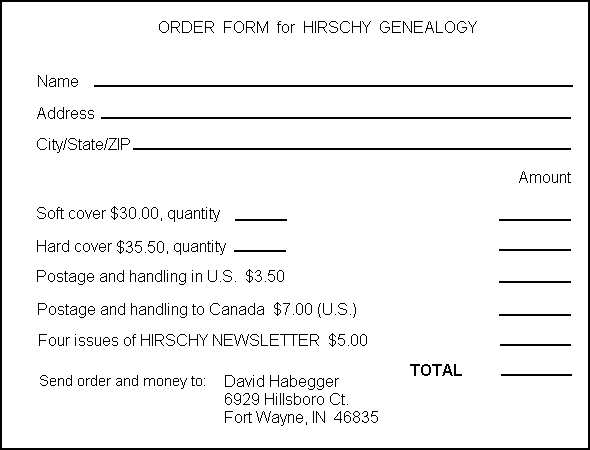
Updated information on descendants that did not got into the Hirschy Genealogy will also be included from time to time. Copies of The Hirschy Genealogy are still available. Hard bound are $35.50 and the soft bound are $30.00. Include $3.50 to cover cost of mailing. Some persons have purchased copies for all their children. one ordered seven copies! These make a great Christmas present for your children or grandchildren as well as your sisters and brothers and parents. There are a limited number available. To be sure of a copy, order soon. Since you have interest in the Hirschy history, you might want to explore other histories that deal with our heritage. more are some you might want to purchase or chock out through your public library. On our Swiss background, the beet information can be obtained from Gratz, Delbert. Bernese Anabaptists and Their Amerlcan Descendants. There is a 1994 reprint of the 1953 edition. Obtain this excellent reproduction by Olde Springfield Shoppe, P.O. Box 171, Elverson, PA 19520-171. Cost $18.96 plus $2.50 for mailing. |
For a general book on the Mennonites and Amish try the recently revised: Dyck, C.J. An Introduction to Mennonite History. Herald Press, Scottdale, PA. 15683 For a book on the Amish history road: Nolt, Steven M. A History of the Amish. 1992, Good Books, Intercourse, PA 17534. Since the publication of The Hirschy Genealogy contact has been made with a descendant of Joseph Klopfenstein (5.7) and Arminta Barnes. They are Russ and Sherry (Klopfanatein) Clair of Rochester Hills, MI. They ordered a copy of the book as soon as they learned about it and then wrote: "Just a note to say how wonderful this book is. We received it today. in your newsletter #3 you mentioned missing data on Joseph, Jacob, Samuel, and Seth Klopfenstein. My husband's branch is Joseph and I have found Jacob's family. I will get updates for you. I'll try for find Samuel. There is no Seth. Joseph, Jacob and Samuel have a sister Emma who married Seth Wyse. However, I will compare the data in the book and see if I can help fill in some gaps. The Jacob descendants were shocked to got my call and will be excited to hear about the book. You have done a "wonderful" job. Noah and your other ancestors would be so proud of you." Thank you, Sherry, for your kind words. |
| ||