|
PLANNED FOR JULY 30 family that arrived in the United States in 1836 are invited to participate in the HIRSCHY GATHERING that will be held July 30 in Riverside Center, Decatur, Indiana. Activities will begin at 3:00 p.m. Here you can: - register and find your family group, - meet your relatives from near and far. - look at displays of photos and family histories. - interview the older persons asking about their memories of their parents and grandparents. - listen to stories told by older persons. - make a video of persons you talk with, - begin making a family tree. Bring your children for some group activities that will interest them. We will have a potluck carry-in meal for our supper, Bring food and beverage you would like to share and your table service. A program is being planned for the evening. AND GENEALOGY family is being prepared by David Habegger (a third generation descendant)for this special event. All descendants we could obtain information on will be included. In it will be the history of the Hirschy family back to 1650 in Switzerland. Do you know our ancestors lived in a cave house in Switzerland for a number of years? Photos of that home as well as the one in which they lived just prior to coming to America will be in. |
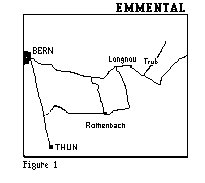
Brief histories of other families who have married Hirschy descendants will be included. Some of these are: Roth, Klopfenstein, Yaggy, Zehr, Sprunger, Habegger, Neuhouser, Augsburger, etc. If you have not answered a request for information send it in immediately to have it included in the book. It must be received by Feb. 15 to be assured of inclusion. A price for the book has not been set since the book is still in preparation.' The next issue of the newsletter will have further information and an order form, This information will be sailed to you early in April. First of all, we are Hirschy descendants. No, we are not descendants of the Hershey family of Pennsylvania which is well known for their candy bars, but it is possible that we are distantly related. Both families originated from the same area of Canton Bern, Switzerland. The name Hirschy comes from the Swiss/German word for deer - Hirsch. The name may have been given them for their hunting ability, or their ability to run swiftly over the mountains of the area. Secondly, we are Emmentalers, that is descendants of people who lived for several centuries in the Emmental (Em3e valley) of Canton Bern, Switzerland. The family is registered in the village of Trub located 6km frog Langnau, (see map) Here civil records go back to the 1600s. Thirdly, our forebears were part of the Teutonic tribe Alimann that entered Switzerland about 500 A.D. Their dialect is one of the five national languages of Switzerland, |
Hirschy and Julianna Frey. Philip was born Nov. 16, 1787 in the community of Le Locle, Canton Neuchatel, Switzerland, Julianne Frey was born Nov. 13, 1798 in the community of La Chaux-de-Fonds. They were married Sept, 23, 1820. To Philip and Julianne were born seven children that lived to adulthood and two that died in infancy. Those who lived were: 1.Johannes, b, Dec. 17, 1821 2.Julianne (Anna),b. May 5, 1823 3.Philip, b. Apr. 17, 1824 4.Louis, b, May 23, 1826 5.Marianna, b. March 27, 1827 6.Maria, b, July 12, 1828 7.Rosina, b. Oct. 8, 1830 The family lived on various farms in the area of La Chaux-de-Fonds, Le Locle, and Les Brenet in Canton Neuchatel for the children's births are recorded in one or the other of these communities, In the 1830s the family was living on the farm known as Bas de Brandt, It is located at the bend of the Doub river 13 km north of La Chaux-de-Fonds in Canton Neuchatel. Here the father died Dec. 22, 1831, He probably died of a heart attack for he died while carrying a load of hay in a large basket on his back. Julianna's father, Johannes Frey, along with some family members had already come to America arriving in March 1824, When he learned that his daughter's husband had died, he wrote her that if she could find a husband he would assist the family in settling in America, How does a widow with seven children, the oldest only ten years of age, go about finding a likely prospect? She seemingly took the nearest available person, He was Christian Horn, their hired worker on the farm. Julianne and Christian Horn were married January 14, 1834 at Courtlary. |
|
Johannes Frey kept his promise to his daughter. When he got word that she was married he began building a house for them in the vicinity of Maximo, OR. He may have also helped them financially to make the trip as well. Christian Horn with Julianne and family left their home in June and arrived in New York on July 8, 1835 on the ship Richmond. On the ship list his age is given as 24. Thus he was probably born in 1811. Julianne's age is given as 36. When Christian Horn and Julianne arrived in Stark County, Ohio in July 1835 they not only had Julianne's seven Hirschy children, but they also had one of their own who was a year old. He was named Christian after his father and he was born gay 22, 1834. Two other-children were born to them Lydia, b. Aug. 2, 1836 and Joseph, b. Feb. 14, 1839. Johannes died two years after his daughter and family's arrival, in 1837. He was buried in the Amish- Mennonite Cemetery located west of Freeburg about a quarter of a mile north of the intersection of highway 135 and Paris road. The small cemetery is found along a private lane just vest of Paris road. One would hope that having experienced the death of a husband, the uprooting experience of leaving a home in Switzerland, and having gone through the adjustment of establishing a new home in Ohio that things would go well for the family. But that was not to be. Julianne died just a few weeks after the birth of her twelfth child in March 1839. She was just 40 years of age. Her first husband, Philip Hirschy, had died at age 44. She is buried in the same cemetery as her father but no stone marks either grave, Christian Horn married a second time to Magdalena Blaser and they had six children: John, Elizabeth, Mary, Anna, Rosina, and another daughter who married Lutz. We do not know what happened to the Hirschy children immediately following the death of their mother. |
Interest in family history has been carried by a number of Hirschy family members. Solomon Hirschy, a son of Louis Hirschy (4) wrote to a niece that when he was a boy his father used to tell the family traditions as they sat around the table in the evening. Those were the days when there was no radio or TV programs to listen to so the family was probably more ready to hear their father tell stories about their history. Solomon wrote some of what he heard from his father in letters to his niece, Barbara Hirschy Habegger (4.1.5.5). Noah C. Hirschy, a son of Philip Hirschy (3)was probably the first to collect information on the descendants of the first family to arrive in America. Letters written in 1892 requesting information are in possession of the author. Some who sent in information indicated that they desired to have a copy of the book when it was ready. That was not to be for N.C. Hirschy died in 1925 before he ever got the information published. After the death of N.C. Hirschy his nephew Walter Hirschy (3.8.1) obtained a copy and began to add to it with the intention of printing what had been gathered. But death again prevented this from happening. Walter died in 1934. Subsequently some families put together information oft their particular families, Then a third generation descend- ant, David Habegger began to gather family history after his parents returned fro& a stay in Switzerland in 1951. They had gathered some information about some of their ancestors and in talking about it to David he became interested in learning about more of his forebears. In following various leads he learned of the efforts of Noah C. and Walter Hirschy and was able to obtain a copy of their work in 1958. He then began to have the vision of completing the genealogy and with the help of his mother, Barbara |
Hirschy Habegger, and sister, Lois Habegger, began to work toward that end in the early 1960s. But there was never enough time to give to the effort so the project could be only worked at sporadically. Now that he retired in August 1991, time and a computer were available to give renewed impetus to the task. It is planned that the vision of Noah C. and Walter will finally be completed in 1994 in time for the GATHERING. COMMITTEE A committee has been formed to plan for our HIRSCHY GATHERING that will take place on July 30. Members of that committee are: (The number behind their name indicates the ancestor from which they or their spouse are descended) Kenneth Hirschy (4), Decatur. Chr. Cletus Hirschy (4) Ft. Wayne. V-Ch. Connie Zollars (3) Fort Wayne. Sec. Dick Beitler (3), Berne. Treas. Melissa (Mrs Jim) Beitler,(3) Berne Barbara Bulmahn (1) Decatur, David Habegger (4) Fort Wayne, Barry Humble (Dianna 6), Decatur, Gary Neuen (4), Fort Wayne, Jeanette (9) and Tillman (3) Sprunger, Berne, James A. Witmer (5) Spencerville. As you can see we have a good representation from the various members of the first family. There will be a number of sub- committees formed to do the planning for the activities that are envisioned. If you have ideas for the GATHERING, and would like to help with some of the activities, contact any of the members named. We would like to have an event that will be of interest to all ages. The HIRSCHY GATHERING will be held on Saturday afternoon and evening of July 30 which is the weekend that Berne, IN has its annual SWISS DAYS. These begin on Thursday evening July 28. Plan to come to Berne to enjoy the activities of this whole weekend. Get in touch with your Swiss heritage by coming to this event. Details will be sent to you in Apr. |
|
The first person to begin collecting Hirschy family information was Noah Calvin Hirschy. He was collecting such information as early as 1892. In 1907 when he his family were in Switzerland he found the farm where his father and his father's brothers and sisters lived with their parents in the 1830s. He thus holds an important place in the family and so we here introduce his to you. Noah Calvin Hirschy was a very unique person. Born Feb. 2, 1867 in a log cabin in Adams County, Indiana, he was the tenth of eleven children born to Philip (3) and Mary Rich Hirschy. His parents were members of the Amish community that had begun to settle in the forests of Adams County, Indiana beginning in 1837. Nary's father, Jean Rich (Johannes Reicher) was the first Amish/Mennonite minister to come to this new territory. Philip and Mary Hirschy had very limited education, probably the equivalent of third or fourth grade. Their children attended the public school in their community and here Noah began his educational journey. Teachers were needed in these schools and persons were placed as teachers with limited training. Noah's ability was recognized for when he was 18 he was asked to become a teacher. We do not know whether N.C. had more than an 8th grade education at this point. His brother, David, was already a teacher and encouraged Noah to get further education to prepare himself for the job. He attended summer classes in the Normal school in Portland, IN in 1886 and 1887. He then taught in a country grade school for four years. It appears that attending summer school just whetted Noah's appetite for sore education, It was not customary for the Amish church to give permission to its members to obtain any sore education than was necessary to teach in the country grade schools. So Noah, who had |
united with the church, went to the Ministers to get permission to go for additional education. In his diary Noah remarks that the Elders could not agree with his request. We do not know whether this means his request was denied or whether there was not a consensus of what should be permitted, In any event Noah entered Tri-State College in Angola, IN and attended two years, 1889-91. Following this Noah became the principle of the school in Berne for the year 1891-92. That year he began attending the First Mennonite Church in Berne. The leading minister was the young vigorous Samuel P. Sprunger who had received three years of ministerial training in the Wadsworth Institute in Wadsworth, Ohio, the first Mennonite school of this kind in America. Because of his appreciation for this church, Noah went to his home congregation (which had now taken on the name Defenseless Mennonite Church) requesting his membership be transferred. He was told this was not the custom of the church so he united with First Mennonite without such approval. The year 1892 began a new direction for Noah. The First Mennonite Church had its roots in Switzerland with a group that had opposed Jacob Amman, the founder of the Amish Church in 1693, First Mennonite was also a member of the General Conference of Mennonite which was a more liberal minded group than the newly formed Defenseless Mennonite Church conference. The ministerial school in Wadsworth was no longer functioning, but the Wadsworth Mennonite Church had begun its own school and in the fall of 1892 Noah enrolled in this school, probably to study the Bible and Mennonite history. Noah's gifts were recognized in Wadsworth and the following year he was asked to be the principal of this institution and to become the assistant to the pastor of the church. The Wadsworth Mennonite |
Church was one of the most progressive congregations in its Conference having had the influence of the Wadsworth Institute for the eleven years of its existence. The attitude of many Mennonites, as well as the Amish, was that higher education was unnecessary, and even a danger to faith. Those who dedicated their lives to the service of God might get appropriate further education. To prepare himself for this progressive town church's ministry Noah enrolled in Oberlin Theological Seminary. He was then ordained for the ministry by the senior pastor, Ephraim Hunsberger and the pastor in Berne, S.F. Sprunger. Another major event in Noah's life was his marriage to Augusta Hunsberger,the daughter of the senior pastor, He married her Sept. 5, 1895. In Oberlin College and Seminary Noah enrolled primarily in courses in old and New Testament and Theology. He also studied Hebrew and New Testament Greek along with Classical Greek , latin, and German language and literature. Plant life was always of interest so he also took courses in Botany and Biology. He completed his college and seminary studies receiving both the B.A. (1897) and Bachelor of Divinity (1898)degrees. By the time he completed this course of study he was probably the most educated pastor in any Mennonite church. Noah's gifts were also recognized by the larger Mennonite church. He was elected to the Home Mission Committee of the General Conference and in 1898 as the moderator of the Middle District Conference, Then in 1900 he was chosen to become the first president of the newly organized college in Bluffton, Ohio. Noah continued his studies by enrolling in the University of Chicago Divinity School specializing in Old Testament studies, Here he also studied Aramaic and Arabic. He received the N.A, degree in 1906, But this was not the end. Noah toot a sabbatical from his position at Bluffton College and went to the |
|
University in Bern, Switzerland to work for a doctorate. He was granted the Ph.D. degree magna cum laude (with great distinction) in the spring of 190?. In receiving this degree he stands with two other men (C. Henry Smith and Samuel K. Mosiman) as the first Mennonites in America to receive this degree. All three received the degree in 1907, but what is most remarkable is that both Hirschy and Smith grew up in Amish homes. Noah ended his relationship with the Mennonite church when he left Bluffton College for the presidency of Redfield College in South Dakota in 1908. After serving there for five years he left the college scene for seven years. In 1920 he accepted the Position of professor of Botany in Berea College, Berea, KY. There he died in 1925, A fuller account of his life will appear in the Hirschy history and genealogy. While in Switzerland Noah went to the archives in La Chaux-de-Ponds to locate the farm where the Hirschy family had lived prior to coming to America. Nowhere in his writings does he mention where earlier Hirschy ancestors had lived prior to moving to Canton Neuchatel, The records in La Chaux-de-Fonds no longer exist as the building housing the records burned during the 1960s. Citizenship in Switzerland is registered in a person's HEIMAT, or home village. Beginning in 1672 Switzerland required all residents to register in the Parish (county) in which they were living. This was the start of their civil records, Since that date, all male descend- ants and their children are registered in that village. The daughters are registered at birth, but when married their name goes to the village of their husband with the notation of their previous heimat. Since the name Hirschy (or Hirschi) is common in Switzerland, Hirschy families are registered in eight different villages in several |
Cantons. As he began to research the Hirschy family the author wondered whether he would ever discover the Hirschy heimat since Noah C. Hirschy never mentioned it. Thus it was with real delight that he discovered in 1974 that his Hirschy forebears are recorded in the sane village as his Habegger forebears, the village of Trub in the Emmental of Canton Bern, Philipp Hirschi and Julie Anna Frey (sic,) and their children are recorded in Volume 3, page 186. The Frey family heimat is Rothenbach, also in the Emmental, Our Hirschy forebears left the Emmental some time prior to 1736, the date a Hirschy child was born in the vicinity of Courtelary in the Jura. Then by 1741 they were living in the community of La Chaux-de- Fonds, Canton Neuchatel. So our Hirschy forebears lived in Canton Neuchatel for 94 years prior to coming to America, ![]() The village of Trub lies nestled in the little Trub valley with numerous small branching valleys, Driving up the valley one see high pastures and fields that were carved out of the forest centuries ago. In this valley and on the hills one sees single or double households with cows grazing in the pastures. The village was initially started as a Catholic monastery in the 14th century. The monastery was given the surrounding land to make it |
viable. The monastery rented au,, homesteads to various families, These early records are extant and should be researched to find out where the Hirschy family lived before the Reformation, Following the Reformation the monastery was closed and the renters continued to lived on the farms, paying rent to the city of Berne. Trub has about 27000 registered citizens scattered in various Cantons and in various Parts of the world. Though it is a tiny place, it can boast to having the second highest number of citizens of any village or town in Switzerland, The cities of today have many residents, but they are registered in the various heimats of the country, And if one would count all the descendants of these sturdy forebears, the number would be many thousands. It was impossible for the small valley to contain the numerous offspring, so emigration to other Places started the second half of the 17th century and continues at the present time. or if you want to add names to the mailing list, send in the informat- ion with your label to David Habegger, 6929 Hillsboro Ct., Fort Wayne, IN 46835. If you want to help defray the cost of producing and mailing this newsletter, you may send a contri- bution to Dick Beitler, Treas. 2145W 700S, Berne, IN 46711. A second newsletter will be sent to you in April giving more details of the July 30 HIRSCHY GATHERING and order form to order copies of the Hirschy Genealogy. Would you like to see this newsletter continue? Do you have articles or information that would be of interest to others. If so, let the editor know.
|